

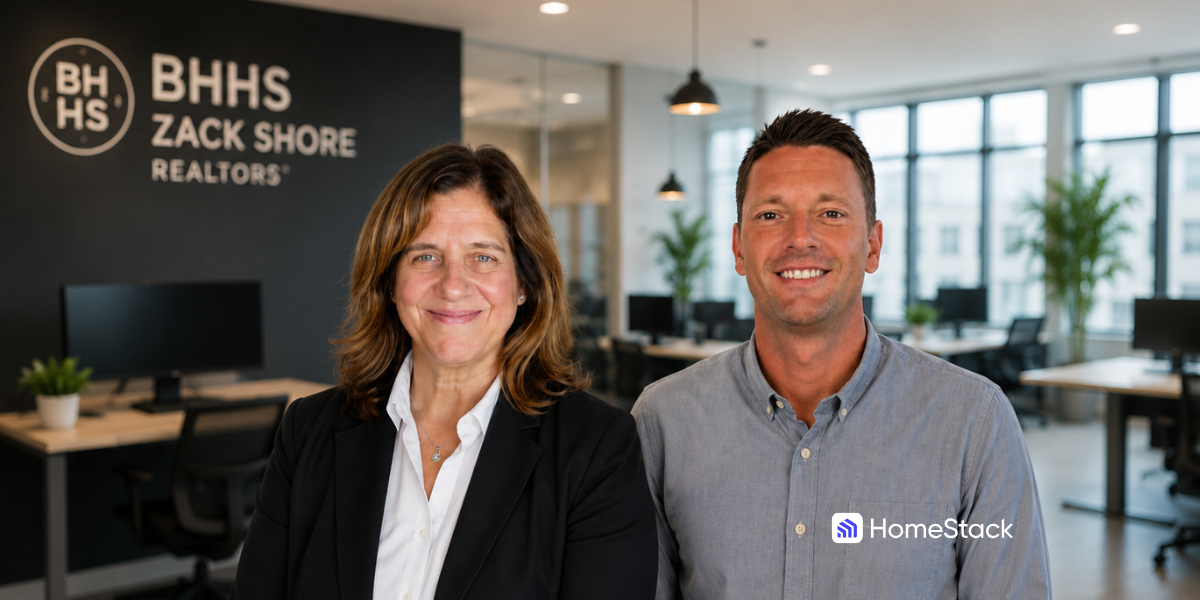
See how one Jersey Shore team built 3,500 app users without buying leads, and the exact tactics you can use to boost your own app engagement.
Increasing real estate app engagement comes down to giving users a reason to open the app beyond a single home search, then staying consistent long enough for that habit to form. Long Beach Island, NJ agents Logan McKenzie and Annemarie Aresco proved the model in real time: a year of daily content built an audience before their app ever launched, and a local resource hub gave that audience a reason to keep coming back. The result is a branded HomeStack app, LBI Views, with more than 3,500 active users and a client pipeline that runs on organic trust instead of purchased leads.
How Logan McKenzie & Annemarie Aresco Built a 3,500-User App and a Thriving LBI Real Estate Business Without Buying Leads
If you've ever scrolled past a sunrise video on Instagram and felt an immediate pull to pack your bags for the Jersey Shore, there's a good chance Logan McKenzie is the reason. Logan, along with his team partner Annemarie Aresco, has built one of the most recognizable real estate brands on Long Beach Island, NJ, and the results back it up. Two years running as Berkshire Hathaway HomeServices President's Circle members, landing in the top 2% nationwide in 2024 and top 5% in 2025, they're not just showing up online. They're closing.
But what makes Logan and Annemarie's story worth paying attention to isn't just the production numbers. It's the strategy behind them, one built on consistency, community, and a branded HomeStack app called LBI Views that now has over 3,500 users and counting.
Here's how they did it, and how you can too.
Ask most agents how they handle first meetings with new clients, and you'll hear some version of the same thing: nerves, a pitch, a handshake, and the slow process of building trust from scratch.
Logan and Annemarie don't have that problem.
By the time a new client meets them in person, that person already feels like they know them. They've watched the sunrise videos. They've seen Logan kick off his flip-flop at the start of a reel. Some have even posted videos of their kids on the beach trying to recreate his signature move.
As Annemarie put it, "We don't have to sell ourselves on anything. They feel like they already know us because we've built that community."
That community, now about 22,000 people across platforms, is the direct result of a year of daily content before LBI Views ever launched. People weren't downloading a stranger's app. They were downloading something from two people they already trusted.
The lesson for other agents is straightforward: your social media presence isn't a marketing channel. It's a pre-meeting. Every video you post is a handshake you're giving before you ever walk through the door. When clients arrive already warm, the whole dynamic shifts. You stop pitching and start helping. See how other agents market their HomeStack app to build that same kind of pre-meeting trust.
One of the more counterintuitive things about Logan and Annemarie's approach is what they don't do. They don't chase. They don't follow up aggressively. They don't flood inboxes.
Logan shared a story that captures their philosophy perfectly. A woman reached out through the app after accidentally clicking a home value request. When Logan followed up and she explained the mix-up, adding that she was actually looking to buy, his instinct was to immediately ask about timelines and availability. Instead, he pulled back and simply told her that buying sounded better than selling anyway, and that they'd be there when she needed them.
Two days later, she reached back out ready to move forward.
"It's brought new life to the job," Logan said. And Annemarie agreed.
Their approach mirrors something most buyers already feel but rarely say out loud: when you walk into a store and ten salespeople rush you at the door, you ignore all of them and go to the one person sitting back. That's who you trust.
The app plays a direct role in this. As Logan described it, they give clients a genuinely valuable tool and let them use it on their own terms. "Here's the app, here's everything you need. We'll be over here if you need us." That kind of low-pressure value delivery is rare in real estate, and clients notice.
The bigger takeaway: pick a strategy, commit to it, and let the consistency do the work. That's what Logan and Annemarie keep coming back to. Consistency across social media, across client relationships, across the app. That's the whole game.
Most real estate apps are built for one type of person: someone actively buying or selling. Logan had a different vision for LBI Views.
He wanted the app to feel useful to everyone who loves Long Beach Island, whether you're a first-time buyer, a longtime homeowner, a seasonal renter, or just someone who drove down for the day and wants to know where to grab lunch.
Inside LBI Views, you'll find restaurant recommendations from the north end to the south end, mini golf, contractors, local services, and a full directory of island resources that Logan personally built out. As he put it, after about a week of inputting everything, his eyes were "bleeding," but it was worth it. At one point he turned to his wife and said he didn't realize how much the town actually had to offer.
The app also features a handful of trusted partners, including their real estate attorney, mortgage lender, and title company, giving clients access to a vetted team from day one.
The resource hub has done something most agents don't think to build: it's made the app valuable to people who aren't ready to buy or sell yet. Those people are staying engaged, recommending it to friends, and becoming warm leads over time because Logan and Annemarie stayed top of mind without ever pushing a listing at them.
If you're building a branded app and only filling it with IDX search, you're missing the bigger opportunity. Build something the whole community wants to use, the same way this hyperlocal marketing approach turns an app into a community fixture.
See the full set of tools HomeStack agents use to build a resource hub like this on the HomeStack features page.
For all the confidence that comes through in Logan's daily content, he'll be the first to admit that launching LBI Views was terrifying.
He spent a year and a half posting videos before anyone was really watching. The first six months were quiet. No viral moments, no sudden surge, just Logan showing up every morning and putting content out anyway. "That was a tough pill to swallow," he said.
By the time the app launch arrived, the anxiety followed. Logan was hoping, genuinely hoping, for 75 downloads in the first 24 hours. He pulled Annemarie aside and told her that if they hit 75, he'd consider it a win.
They hit 1,200.
"4,000 people later," Logan said, laughing. They're now sitting at over 3,500 active users, a number that has completely blown past anything he imagined when he was posting sunrise videos to an audience of almost no one.
The reason it worked wasn't luck. It was that year and a half of showing up before there was any payoff. The community was already there when the app launched. They just needed something to download.
For agents sitting on the fence about building their own app or committing to a content strategy, Logan's story is worth sitting with. The hardest part isn't the launch. It's the months before it when nothing seems to be happening and you keep going anyway. That's where the 1,200 day-one downloads come from.
Most real estate apps exist for one moment: when someone is actively searching for a home. Logan and Annemarie built something that people want to engage with every single day, whether they're on the island or thousands of miles away wishing they were.
At the end of every video Logan posts, he flashes the LBI Views app. That simple, consistent move alone drives a steady stream of downloads every time a new video goes up. But the community-building goes well beyond the screen.
They've had LBI Views stickers out on the island, and now they're taking it a step further with branded coasters, dropping them at local restaurant bars and letting bartenders sprinkle them around naturally. The plan is for Logan to post a video calling on followers to snap a photo wherever they spot one. It's low-key, it's fun, and it's exactly the kind of thing a tight-knit beach community gets behind.
"We're not gonna flood the island with them," Annemarie said. "It's turning into a little game. And people love that stuff."
And then there's the giving back piece, which might be the most powerful community driver of all. Logan and Annemarie are deeply involved with David's Dream and Believe Cancer Foundation and Saint Francis Church's food pantry. When Logan started encouraging his audience to donate food to Saint Francis, the response overwhelmed the church. Literally. The food pantry had to reach out and ask them to pump the brakes because they couldn't keep up with the volume. One man drove from Brooklyn just to drop off donations after seeing Logan's video, found Logan in person, and shot a video on the spot.
The reach goes far beyond Long Beach Island too. Logan gets messages from Colorado, Utah, California, and beyond from people who grew up going to LBI, moved away, and now start their morning with his sunrise video because it brings the beach to them. "Thank you for bringing the beach to me every morning," one person wrote. "I was having kind of an okay morning."
That's not a real estate audience. That's a community. And when those people are ready to buy a shore house, or when their friend mentions they're thinking about LBI, there's only one name they know. It's the same pattern behind how a coastal realtor uses his app to build relationships and a brand.
Logan and Annemarie don't buy leads. Not from Zillow, not from any portal. For a lot of agents, that sounds like leaving money on the table. For them, it's been the entire key to building something sustainable.
The organic approach, social media content driving app downloads, app engagement building trust, trust converting into referrals and repeat business, means that every client in their pipeline arrived because they wanted to be there. Not because an algorithm served them a generic ad.
Logan shared a moment that stuck with him: a client called and Logan later discovered the person had already been using the app before they ever spoke. "How did you even know about it?" Logan thought. That's the kind of organic adoption that only happens when people genuinely find value in something.
The app also changes what happens after the closing. Clients who already have LBI Views on their phone keep using it to search listings, check home values, and browse local resources. They stay connected to Logan and Annemarie naturally, which means when they're ready to buy again or refer a friend, the connection is already warm. As Logan put it, once you have a large enough community built on an organic approach, "the domino effect just happens."
And then there's the chat feature. Logan talked about how underrated it is to simply be on someone's phone. People look at their phones hundreds of times a day. Having a branded app with a direct chat means that when a client has a question, even a casual one, they can reach Logan or Annemarie instantly without having to decide which agent to call or whether anyone will actually know the local market. They already know who they're reaching, they already trust them, and the answer is one tap away.
That's not a lead. That's a relationship.
Logan and Annemarie's strategy isn't complicated, but it does require something most agents aren't willing to invest: time, consistency, and a genuine focus on adding value before asking for anything in return.
Here's the short version of what they've built:
If you want to see it in action, follow Logan at @SurfingRealtorLBI and download LBI Views. It's a clear picture of what a branded real estate app can look like when it's built with a community, not just a conversion rate, in mind.
Ready to build your own? Book a demo with HomeStack and see what a branded app can do for your engagement and your pipeline.
Real estate app engagement grows fastest when the app gives users a reason to open it beyond a single home search. Building content that drives downloads before launch, adding features like a local resource directory and direct messaging, and following up
without pressure are the tactics that turned LBI Views into a 3,500-user app for Logan McKenzie and Annemarie Aresco on Long Beach Island.
Most real estate apps are built for a single moment, when someone is actively buying or selling, so users delete them once that moment passes. An app that also serves renters, longtime homeowners, and visitors with local resources gives people a reason to keep it on their phone long after a transaction closes.
Not a specific follower count, but consistency matters more than size. Logan and Annemarie posted daily content for a year and a half before LBI Views launched, and that runway is what turned their launch-day goal of 75 downloads into 1,200 downloads in the first 24 hours.
Direct in-app chat, a local resource directory, and real-time MLS listing updates give users ongoing reasons to return instead of just a search box. HomeStack apps like LBI Views pair these features with the agent's own branding, so every interaction reinforces the relationship instead of routing users to a generic portal.
It can significantly reduce reliance on it. Logan and Annemarie don't buy leads from Zillow or run paid ads, relying instead on app-driven engagement and referrals for their entire pipeline. The organic approach takes longer to build than a paid campaign, but it produces clients who already trust the agent before the first conversation.
A resource hub that includes restaurants, contractors, and local services gives everyone in the community a reason to use the app, not just active buyers and sellers. That broader utility is what kept LBI Views relevant to renters, visitors, and past clients, turning casual users into referral sources over time.
Start building an audience before the app exists. Agents who post consistently and build trust first give their app a ready base of users on day one, rather than launching to an empty room and hoping downloads follow.


.png)

