

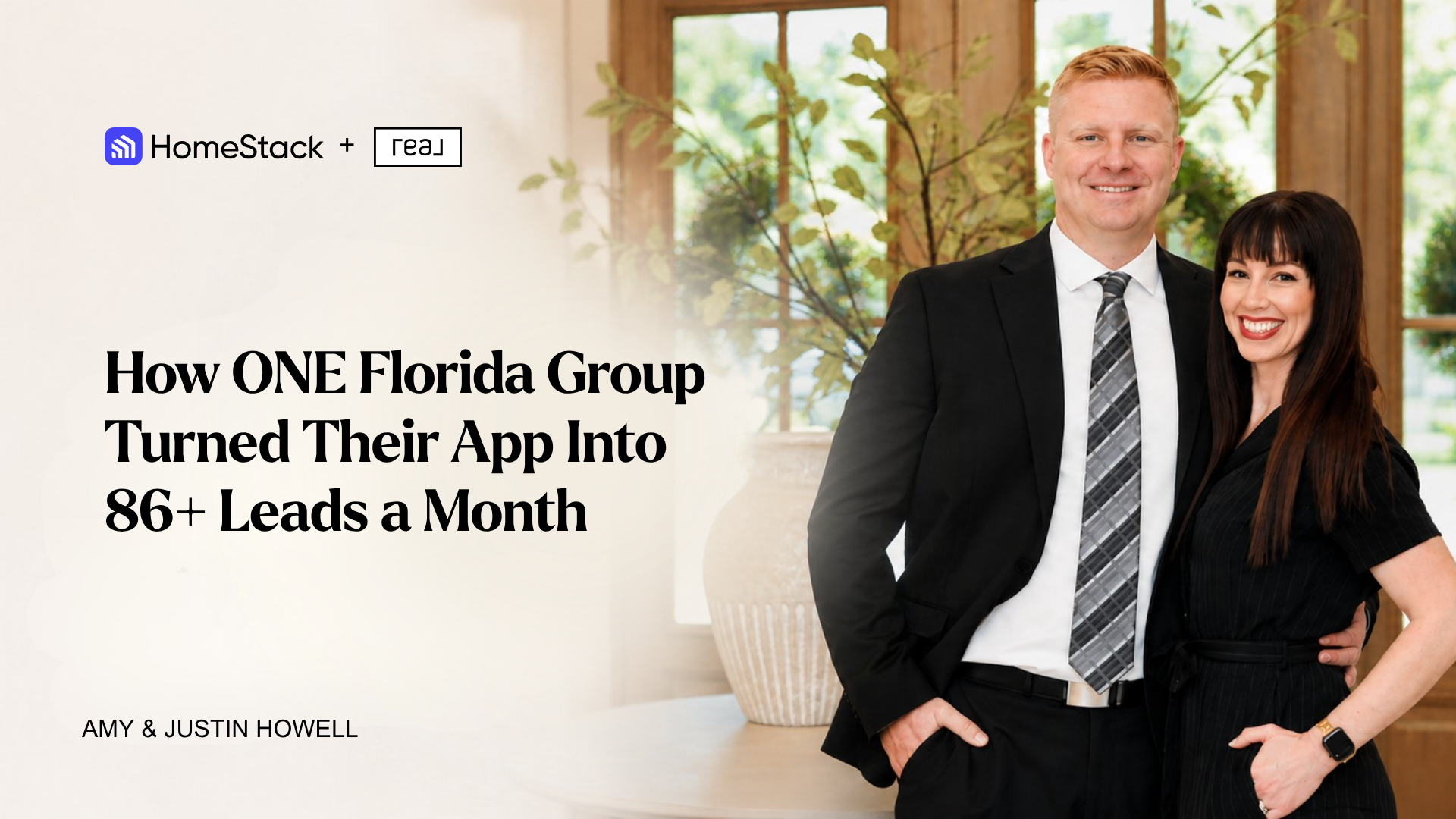
A lead generation app for real estate agents helped ONE Florida Group land 86 leads in a month. See the system behind it.
A lead generation app for real estate agents works when it does three things well: builds in a small amount of friction so only serious buyers follow through, lives on a client's home screen long enough to stay top of mind for months, and lets a real person, not a bot, answer when someone engages. Amy and Justin Howell of ONE Florida Group have proven this model out with their branded HomeStack app, turning it into their second-highest lead source last month with 86 leads, and producing more under-contract deals than any other channel they use.
We sat down with Amy and Justin Howell of ONE Florida Group recently, and it was one of those conversations where you just want to pull up a chair and take notes. Amy is a top 1% agent in Northeast Florida. Justin spent 16 years in the Navy, a good chunk of it in naval intelligence, before turning that same "figure out the system" brain toward real estate tech. Together they run an 11-person team, a YouTube channel closing in on 2,000 subscribers, and one of the smartest lead setups we've come across.
Here's the stat that made us sit up: last month, their HomeStack app was their second-highest lead source, 86 leads, and it actually produced more under-contract deals than any other source they have. Not their biggest volume source. Their best converting one.
So we asked them, how? It turns out it's not luck. It's a pretty simple system, and they walked us through the whole thing.
Justin explained it like this: people find them on YouTube, and by the time they're watching, they already feel like they kind of know Amy. That's the whole point of the channel. So every video ends with a call to action, usually pointing to one of two things: their custom Neighborhood Match Quiz, or the HomeStack app.
Why those two? Because they both take a little bit of effort. And that's actually the secret. Taking a quiz, or downloading an app and verifying your phone number, weeds out the people who are just curious. The ones who follow through are telling you something real: they're serious about moving.
The two work as a pair. Someone takes the quiz, gets matched to five neighborhoods (plus five honorable mentions, because nobody really knows exactly where they want to live), and then gets nudged to download the app to actually go look at homes in those areas. About a third of quiz-takers follow through into the app, and once they do, Amy and Justin know they've got someone worth spending time on.
The takeaway here: don't just chase downloads for the sake of downloads. Build in a little friction on purpose. It's doing you a favor by sorting out who's actually ready.
This is the part that really stuck with us. A quiz result or a buyer's guide is a one-time moment. If you don't grab that lead right away, it's gone. But an app lives on someone's home screen, right next to Instagram, right next to their banking app. Every little push notification is a tiny nudge that keeps you top of mind, without being another email that gets buried and ignored, part of what HomeStack's real-time MLS data and messaging tools are built to do.
And Amy's not outsourcing the human part either. When someone replies to the app's auto-message, it's actually her on the other end, not a bot, not a VA. She says so directly in her videos, too. It's a small thing, but it builds trust fast, and people notice.
The takeaway: a real estate app isn't a form you're trying to get filled out. It's a low-effort way to stay present in someone's life for months, without having to chase them down every day.
One of the coolest things they've built is what they call their Certified Pro Network, basically a vetted list of local vendors, electricians, plumbers, lenders, all built right into their ONE Florida Group app built by HomeStack. Amy started it because she kept fielding the same "who do you recommend for X" questions from people relocating to the area, and she wanted to actually stand behind the answer instead of just shrugging and pointing to Google reviews.
The vendors get push notifications, newsletter mentions, social shout-outs, and in return, they help cover the app's monthly costs. So it's not just a nice feature, it's a small built-in revenue stream too, and it makes the app genuinely more useful for the people using it.
The takeaway: if you're looking for a way to make an app pay for itself, local vendor partnerships are worth exploring. Good for your buyers, good for the vendors, good for your wallet.
Amy doesn't force anyone on her team to use the tech. She doesn't have to. Agents can get their own app seat and can see, in real time, what a lead is doing in the app: what they're searching, saving, favoriting. So when a lead goes quiet over text but is still poking around the app every day, the agent knows the deal isn't dead, that person's just busy. That visibility alone is what keeps everyone checking in and staying consistent.
We asked what advice they'd give an agent who's intimidated by YouTube or unsure if an app is even worth it. Justin's answer was simple:
Amy's parting advice was simpler still: stop comparing your real estate business to everyone else's. Post consistently, get a little better each time, invest in the right tools, and trust that the right buyers will find you.
Amy and Justin's system didn't happen by accident. It took a branded app built around their business, a clear reason for people to open it, and the follow-through to treat every notification and reply as a relationship, not a transaction. Curious what an app like this could do for your business? Book a demo and see it for yourself.
A lead generation app for real estate agents is a branded, easy-to-use tool that combines built-in friction to filter out casual browsers, real-time MLS data, and communication tools like push notifications that keep an agent top of mind long after the first search. HomeStack's branded app model is built around these principles, and teams like ONE Florida Group have used it to turn app engagement into a top-converting lead source.
Results vary by team size, market, and how the app is promoted, but ONE Florida Group's HomeStack app produced 86 leads in a single month, making it their second-highest lead source and their best-converting one.
Many agents pair a lower-commitment tool, like a quiz or a buyer's guide, with their branded app so prospects self-select into a deeper relationship. ONE Florida Group matches quiz-takers to neighborhoods first, then invites about a third of them into the app to browse homes in those areas, which tells the team who is genuinely ready to move.
HomeStack gives agents real-time MLS data, push notifications, and CRM integrations, so an app download turns into an ongoing conversation instead of a one-time form fill. Agents can see what a lead is searching, saving, and favoriting in real time, which is how teams like ONE Florida Group know a quiet lead is still active rather than gone.
Yes. HomeStack apps are white labeled, so teams can build features like a Certified Pro Network of vetted local vendors directly into their own branded experience. See how a white labeled app comes together on the why HomeStack page. ONE Florida Group's vendor partners help offset the app's cost while giving buyers a trusted resource, which keeps the app useful well beyond the initial home search.
Yes. An app that sends timely, useful push notifications stays visible on a client's home screen for months after the first interaction, instead of getting buried like another email. ONE Florida Group credits this kind of ongoing presence, paired with a real person, not a bot, responding to every message, as part of why their app outperforms their other lead sources.
The fastest way to see what a branded app could do for your pipeline is to book a demo with HomeStack's team, who can walk through features like real-time MLS data, push notifications, and CRM integrations, the same tools teams like ONE Florida Group use to convert app engagement into closed deals.


.png)

