How to use custom push notifications to build local authority and outcompete the national portals.
Your app already handles the automated side of push: property alerts, saved search matches, MLS-driven updates, and behavioral nudges are covered. This guide focuses on the other half of your push strategy — the custom notifications that build community trust, drive daily app habits, and create an experience no national portal can replicate.
Zillow captures 226 million monthly unique users. Redfin has speed and MLS accuracy. Realtor.com has decades of brand recognition. None of them can send a notification that feels like it came from someone who actually knows your neighborhood.
That's your edge. And the tool for delivering it is a well-crafted custom push notification — sent at the right moment, on behalf of your brand, about content that matters to a specific community. This guide covers everything your team needs to execute that strategy in 2026: device character limits, content frameworks, timing best practices, and a 90-day roadmap to get started.
Most real estate apps stop at transactional notifications tied to the MLS. The apps pulling ahead in 2026 are using their push channels for something different: community intelligence, market context, and lifestyle content that make buyers and sellers feel like they have an insider source.
This type of content drives daily app opens — not just intent-driven searches. It builds the kind of brand loyalty that keeps users on your platform even when Zillow is one Google search away. And it positions your app as a neighborhood expert, a label no national portal will ever be able to claim in a specific local market.
The Core Principle
One great custom notification a week beats seven generic ones. Real estate is high-stakes and high-emotion. Every custom push should feel like a tip from someone who knows the market — not a broadcast from an algorithm.
Before writing a single message, your team needs to understand the display constraints on real devices. These numbers reflect 2026 defaults on iOS 18 and Android 15 at standard system font sizes. Users with larger accessibility fonts will see even less.

The 30/80 Rule of Thumb (If the above is overwhelming, don’t worry this is the main takeaway to keep in mind)
Write every notification as if the title must stand alone in 30 characters, with the body adding supporting detail in 80. If your message only works when both title and body are read together, it will fail on locked screens. The title must be independently meaningful.
For custom community and market notifications, the structure is simple: lead with the place name and the signal, then give one sentence of context that earns the tap. Here's the difference between a notification that gets opened and one that gets ignored.

These four content tiers should form the backbone of your custom push calendar. Each is an area where your app can build a durable advantage over the national portals — and each gets stronger the more specific and local you make it.

Push weekly or bi-weekly neighborhood-level market stats to users who've shown interest in a specific area. Median price movement, inventory change, average days on market, and a directional signal ("up 12% this month") are the four data points that matter most. Keep the notification tight — two numbers max — and link to a fuller market report inside the app.
Send these at the micro-neighborhood level, not the city level. "Montrose is moving" lands differently than "Houston is moving." Specificity is what makes it feel local, and local is what Zillow cannot fake.
This is the highest-moat content category and the most underutilized by real estate apps. Upcoming zoning hearings, school rating changes, new transit proposals, permit activity spikes, and local business openings are all signals that homeowners and buyers genuinely care about — and none of the national portals are surfacing them in a push notification.
Partner with local data sources: neighborhood associations, city planning portals, school district feeds, and local business directories. Even one well-targeted community push per week — sent only to users who've browsed that neighborhood — builds the kind of habitual engagement that no algorithm-driven portal can replicate.
Push content that matches how users think about neighborhoods beyond square footage. A notification about a new farmers market, a park renovation, or a transit expansion in their target area can drive an app open and reinforce that your platform understands what they're really looking for.
This content doesn't need to be sent frequently to be effective. One well-timed lifestyle notification per week, targeted based on area and criteria, consistently outperforms five generic blasts.
Custom pushes don't always have to be breaking news. Seasonal market education content — "Spring inventory is historically at its peak this week" or "Q1 is closing: here's what the data says for buyers" — gives users useful context for their decisions. These are easier to plan in advance, require no real-time data feed, and consistently outperform promotional messaging in engagement metrics.
Understanding where the major portals fall short is the foundation of a smart custom push strategy.
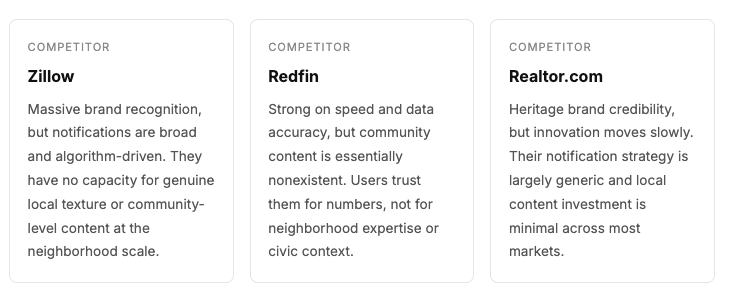
What Zillow Can't Send
National platforms are structurally unable to push: "The Oak Park neighborhood association just voted to restrict short-term rentals — here's what it means for property values in this area." That level of specific, contextual local intelligence is your differentiation. Build your custom push calendar around it.
The data will consistently show that users who receive community-focused custom push notifications have higher app retention, longer session times, and stronger long-term conversion rates. That's the business case for investing in this channel — and it's an investment none of the national portals are making in your market.
The automated alerts are the foundation. Custom push notifications are how you build the relationship on top of it. A well-crafted community update, a precise market signal, a timely civic alert — these are the touches that make users feel like your app knows their neighborhood the way a great local agent does.
Zillow has the traffic. You have the ability to be specific, local, and genuinely useful in ways they cannot be structurally. The custom push channel is where that advantage gets delivered — one notification at a time.


.png)